
While searching for information about Taylor’s well and pumphouse, we came across a true account of an encounter at the well between the engineman, Tom Bailey, and a young man called William Simmonds. Further investigation revealed that Simmonds was a deeply troubled man. This is his story of desertion, petty crime, homelessness and a tragic death.
Warning: This account contains details of self-harm and suicide which may cause distress.
No Work Today
Soon after dawn on a cool, overcast morning in early August,1901, Bill rose and hurried over from his father’s home in Nutley Lane, Reigate, to see Mr. Fairs, George Taylor’s farm bailiff. A good day’s work on the farm would earn him some welcome cash, but today he was out of luck. A spell of rain had set in for the day as he made his way out of town. Mr. Fairs’ office was in Kingswood, some two miles away, and to get there required a steep climb up Reigate Hill which had at least warmed him up. Mr. Fairs had bad news. Any work that he might have had wouldn’t be possible until dry weather returned.
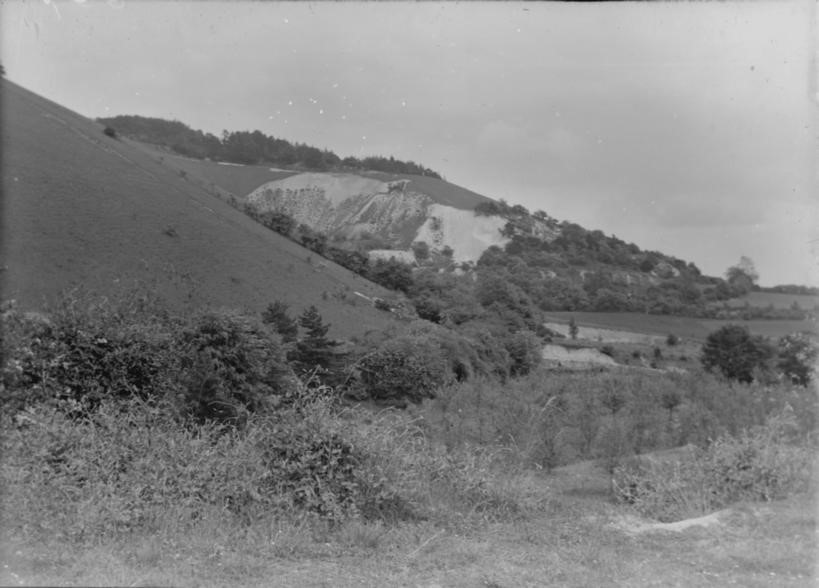
Bill set off back for Reigate disappointed, the rain soaking through his coat and he was now feeling the cold despite it being summer. He put his collar up and drew his coat tightly around his tall, slim figure as he walked briskly back over the hill. His route took him past Mr. Taylor’s new well in the old hearthstone pit under Colley Hill. He knew the engineman, Tom Bailey, who would regularly set the steam engine in the pumphouse running to refill a small reservoir on the hillside a few hundred yards away.
It was still only 8 o’clock and with no other plans, Bill decided there were worse things he might do than spend the day in the pumphouse where he could warm up and dry out his damp clothes. He found the door ajar and stepped inside.
Immediately inside the shed was a short flight of steps leading down. When the well had been sunk about two years previously, the workmen had quickly discovered an underground stone quarry a few feet below the surface, and they had taken advantage of this, setting the steam engine on the floor of the old tunnel some 15 feet down. The stone steps led to a small platform from which he could see Mr. Bailey below him in his shirtsleeves attending to the engine.
“Please, come down and join me. I will probably be here for some time as the reservoir is almost empty and we need to get it filled today. If you have nothing else to do, I would be obliged if you would lend me your company and help me.”
Bill climbed down the ladder into the engine-room and, being 6ft 4 in tall, stood over Tom by some considerable degree. The pumps were almost ready to start up, as Tom had fired up the boiler some time earlier and the gauges were showing a good head of steam. With just a few more adjustments, they could set the pumps working.
Soon the large shed resounded to the quiet rhythm of the little steam engine and the pumps in the well drawing water up and into the iron pipe that fed several parts of Mr. Taylor’s estate with cool, sweet water.
“Take off that wet coat, Bill, and hang it next to mine. It will soon dry off in here. Now, do you fancy some tea?”
They climbed back up the ladder and retired to a small room where there was a little stove and a kettle which was soon bubbling away, and the two men sat down waiting for the tea to brew in a rather fine teapot that Mr. Taylor had provided from the kitchen of his big house, Margery Hall.
Throughout the morning and early afternoon the two men shared the work, which, now the pumps were running well, required little more than watching the gauges, and lubricating various parts of the engine and pump linkage. If the steam gauge needle dropped, it only needed a few shovels of coal in the boiler firebox now and again to get the engine working at a steady pace once more. A more unpleasant task was to rake out the hot ash and clinker, and to carry it in a heavy bucket out to the back of the shed where a pile was slowly accumulating. Now and again, Tom would take this material and spread it around in front of the building, mainly in places where it had got particularly muddy earlier in the year. But that was a job for another day, after the weather had dried up and working outside would be more comfortable.
Late in the afternoon, Tom judged it was a good time to check the water level in the reservoir, about fifteen minutes’ walk away over the meadows below the hill. He wondered whether he should lock up the pumphouse but Bill reassured him he could be trusted to keep an eye on the place until he got back. Tom retrieved his coat from the engine-room and set off, however, he realised he had left his watch and chain hanging on the nail under his coat, since he rarely kept it on his person when he was working out of fear it would get damaged. He set off back, but on entering the pumphouse he found the place deserted. Both Bill and his watch and chain were nowhere to be seen.
He Missed the Boat.
Born in 1871, Bill had a habit of getting into trouble. In 1899, his regiment, the second Somerset Light Infantry was going to be sent to South Africa to the Anglo-Boer War campaign and he was ordered to report for duty. Having travelled to Canada, it was some considerable time before he received the letter which had been forwarded to him by a chum, and he sailed for home. On arriving some days late in Gosport he handed himself in, voluntarily confessed, and on 4th December was charged with desertion and passed over to the military authorities. The 2nd Somersets embarked on the White Star liner “Majestic” on 13th December and set sail from Liverpool for South Africa; whether Bill was with them seems highly unlikely as the regiment was still serving in South Africa during 1901. His record of desertion, justified or not, would stay with him for the rest of his life.
A Habitual Criminal.
The police soon caught up with Bill after he disappeared with Tom Bailey’s watch. He was arrested in Chipping Sodbury on 15th August and quickly admitted to the theft and that he had sold the chain to a man driving donkeys at Box Hill, and the watch to a man in Marlborough for 3s. Neither were ever recovered. In court the police witness stated that a year earlier Simmonds had served a month in prison for the theft of a bicycle in Andover. Bill was sentenced to two months’ hard labour.
Bill’s behaviour never really showed any signs of improving. After his release, he moved back to live with his father in Nutley Lane, but remained a deeply troubled individual. Early in 1902, he announced to his father that he had found work in Purley and he left the house. Subsequently, his father found a suit of clothes and his overcoat were missing, presumably taken by Bill without permission, in connection with whatever employment he claimed to have obtained.
Charged with the theft of his father’s clothes, he appeared before the Reigate Bench on 10th February, where he made quite a scene. As the prosecutor finished presenting his evidence, Bill attempted to violently kick the police officers on either side of him. Several constables tried and failed to subdue him, and he continued shouting loudly. The Head Constable stated that the prisoner had torn up his clothes while in the cells, and when the proceedings came to a close, it took four or five constables to restrain him, fastening his hands behind his back and removing his boots before they could return him to his cell.
When he returned to the Bench for sentencing a few days later, he was very subdued, and cried profusely. The Mayor, presiding that day, said he was a disgrace both to himself and to his father, who he knew to be as good and honest a parent as anyone might wish to have. Simmonds was committed to six months with hard labour.
In the following years, as he continued to commit a number of further offences, it became clear that Bill Simmonds had resigned himself to a life of casual employment (as a gardener), homelessness and petty crime. He spent much of his time in south west England, but returning to the Reigate area regularly.
In 1905, he was apprehended in Reigate, once more on suspicion of desertion, and immediately admitted to breaking into a house in the Exeter area. This resulted in his next conviction for which he received another six-month sentence with hard labour.


An Arrest in Cornwall
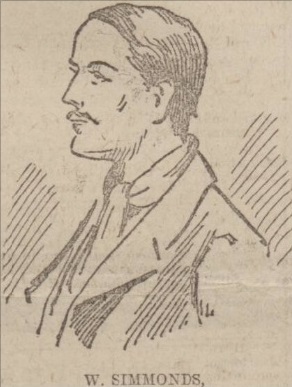
For some years, the newspapers remained silent about Bill’s activities. However, it is unlikely this was due to any improvement in his personal life or any better circumstances he may have enjoyed. In the middle of winter, in January 1914, Bill found himself in the west of Cornwall and in trouble once more, and in quite a dramatic way.
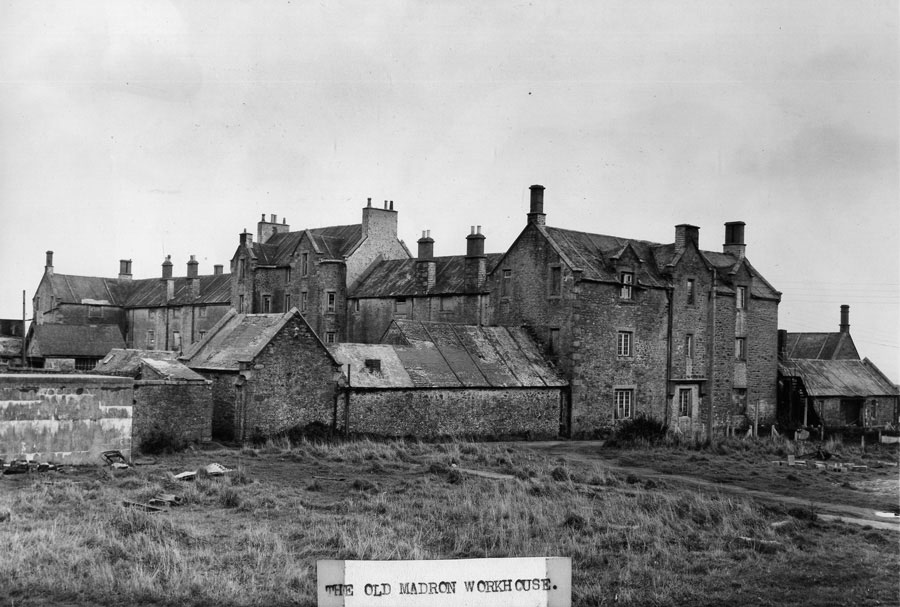
Unable to get any work, he had ended up in Madron workhouse where, in order to discourage tramps taking advantage of the meagre shelter provided in the Casual Ward there, they had stopped lighting fires for warmth. In desperation, he made his way to St. Ives, collecting some stones on the way.
His plan was to get himself arrested as, in his thinking, this was an almost guaranteed way to receive shelter, food and some warmth. The first stone went through the shop window of Mr. Coulles the draper, on Fore Street. On hearing the commotion, Mr. Coulles and several other traders came out and confronted Simmonds. They were unable to prevent him throwing a second stone through the shop window of Mr. Quick, the jeweller.
He threw a third stone at the window of Mr. Curnow’s premises but failed to break it. By this time, the local traders had apprehended Simmonds and escorted him to the police station where they reported on what had been happening. Simmonds made it quite clear that being arrested was precisely what he wanted to happen, saying “I can’t get any work, and was nearly dead in the workhouse with the cold,” and, “I want to be locked up.”
Simmonds was committed for trial on two separate charges at the County Assizes in Bodmin. He received a prison sentence of five months, which he may well have oddly welcomed as it meant he would only be released in the spring with the singular prospect of warmer weather beyond that.
The Shock of the Front Line
Of course, prison wasn’t the only place where Simmonds might expect accommodation and food to be provided for him each day. There was also the Army. Once it became clear that the war declared in August 1914 would not “be over by Christmas,” large-scale recruitment of soldiers became an existential issue for the United Kingdom. Various campaigns were put in place encouraging men to join up. It wasn’t until January 1916 that compulsory conscription was introduced for the first time. In March 1915, Simmonds voluntarily enlisted in the 8th Devonshires and was despatched to France to serve on the Western Front.
Whether he was traumatised by battle, or was simply unable to cope, he was tried for desertion in March 1916 and sentenced to be shot. This was subsequently commuted to five years’ penal servitude, and later further commuted to two years’ hard labour. Eleven months into his sentence he was released and transferred to a mental hospital and then returned to England with foot problems in March 1917.
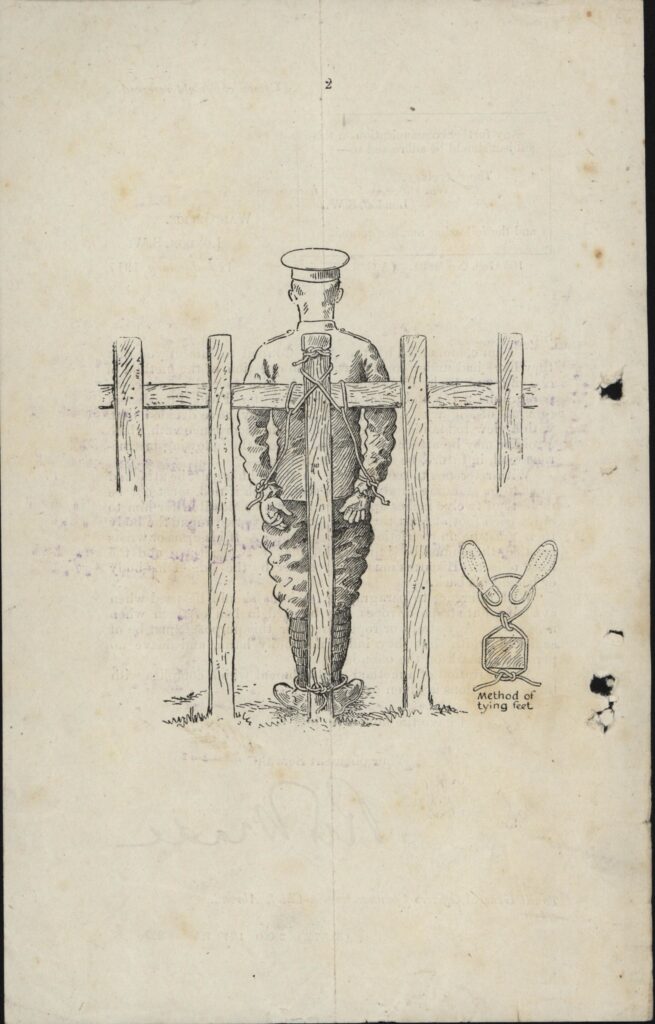
His return to England was only temporary. In September 1917 he was sent back to France to serve with the Expeditionary Force and almost immediately subjected to “Field Punishment No.1” for 28 days for “irregular conduct.” This punishment, abolished in 1923, required the subject to be restrained with cuffs and fetters, and tied in a standing position to a fixed object like a post or gun-wheel for up to two hours each day, with a “day off” every fourth day. There was often an element of hard labour as part of the sentence as well.
Discharge: Back to a “Land Fit for Heroes”
After serving out his four weeks’ punishment, he was admitted to a mental hospital on 3rd November 1917, and six days later returned to England. He was finally discharged from the Army on grounds of “confusional insanity,” leaving Whitchurch Mental Hospital in Wales on 23rd October 1918. He had been detained at Whitchurch with shell-shock, frozen feet and epilepsy.
Simmonds made his way back to Redhill, where he found some employment again as a gardener. Sadly, possibly due to his mental condition, he found it impossible to hold down a job, and he started to tramp the roads once more. He had applied to the Redhill Pension Office but his application for an Army pension was denied, and furthermore the Unemployment Office would not allow him any money.
Torrington Workhouse: the Kind Colonel
For six months, he drifted westwards through Devon, Somerset and Cornwall, his familiar tramping ground before the war. He eventually arrived at the Torrington Workhouse in May, 1919. Now aged 48, Bill drew pity from the Chairman of the Board of Guardians, Colonel R.A. Moore-Stevens. Hearing that Bill had received little help from the Redhill Pension Office, the sympathetic Colonel felt obliged to offer help, stating he had done his duty, suffered, and ought to get a pension. Believing that it was better to look after soldiers and not treat them as vagrants, the Chairman allowed Bill to stay and would let him know what could be done for him.
Moore-Stevens called on Mr. W.R. Hooper of the Torrington Employment Exchange for advice. His enquiries showed that Bill had not been entirely forthcoming over his record of desertion and consequent imprisonment, and that because his insanity had come about during his incarceration and not while on active service, he was not entitled to an Army pension. Furthermore, Bill was considered “fit for work and unable to obtain it” which disqualified him for any out of work payments.
We don’t know what happened to Bill after this. He died in tragic circumstances in 1924, at the age of 53. His case at Torrington had received some notoriety, the story receiving the attention of the Western Times, the Morning Post, and “John Bull”, a magazine owned at the time by Horatio Bottomley M.P. and used as a platform for his trenchant populist views. “John Bull” was utterly scathing of the refusal of the unemployment office at Redhill to grant Simmonds any payments, stating “This is not the first complaint from soldiers about that office.”
Epilogue
Throughout the wood, early spring flowers had already started to appear – lesser celandines, clusters of wood anemones, and primroses. People were beginning to visit the woods to find wild flowers to take home. The cold winter nights were now only a memory and milder, sunnier days had produced a spread of delicate flowers beneath the trees for that brief period of the year when the sun’s rays could still penetrate the leafless canopy above. In a few weeks, bluebells would start to grow before summer’s shade returned to the woods.
The sounds of early spring fill the air. A woodpecker hammers away at the trunk of a dying tree. Early lambs cry out for attention in the nearby fields. A gentle southerly breeze drifts through the high branches, but none of this can bring Bill any pleasure now. Bill will no longer feel the relief of spring sunshine and dry feet. His life had been reduced to one of walking from town to town hawking bootlaces, but few people were interested. With the only certain prospect being that of having no income, no home and perpetually looking for food to sustain an aging body, Bill concluded there was no future worth striving for.
This wood usually attracted local people seeking some colour and tokens of the coming spring to brighten up their cottages. But this year, a man out looking for flowers had been confronted by the sight of a vermin-eaten corpse hanging from a tree. He had cut the man down and ran to the nearby brickworks to telephone for the police to attend. Unidentified, the body was described as being that of a man, evidently a tramp, about 35 or 40 years old. Perhaps Bill’s height lent him a deceptively youthful appearance.
This year, the flowers remained undisturbed. Bill was taken to the mortuary to await identification. The story spread quickly, and nobody was keen to venture into the wood at Liverton Farm looking for flowers. Police enquiries eventually identified the body as being that of William Simmonds. Were it not for his manifold petty crimes and misdemeanours, his story would have been quickly forgotten. Happy tales rarely draw the attention of the Press, and good stories about ordinary people hardly ever make it into the papers. Bill would have had occasional good times and memories, but these went with him to an unmarked grave.