
Can We Find The Windows?
A Story of Neglect, Abandonment and Demolition


While we wait for a convenient day to bring a digger onto site to clear out the central pit of the pumphouse, we are looking at some other features of the remains which may reveal a little about what happened to the building when it fell out of use.
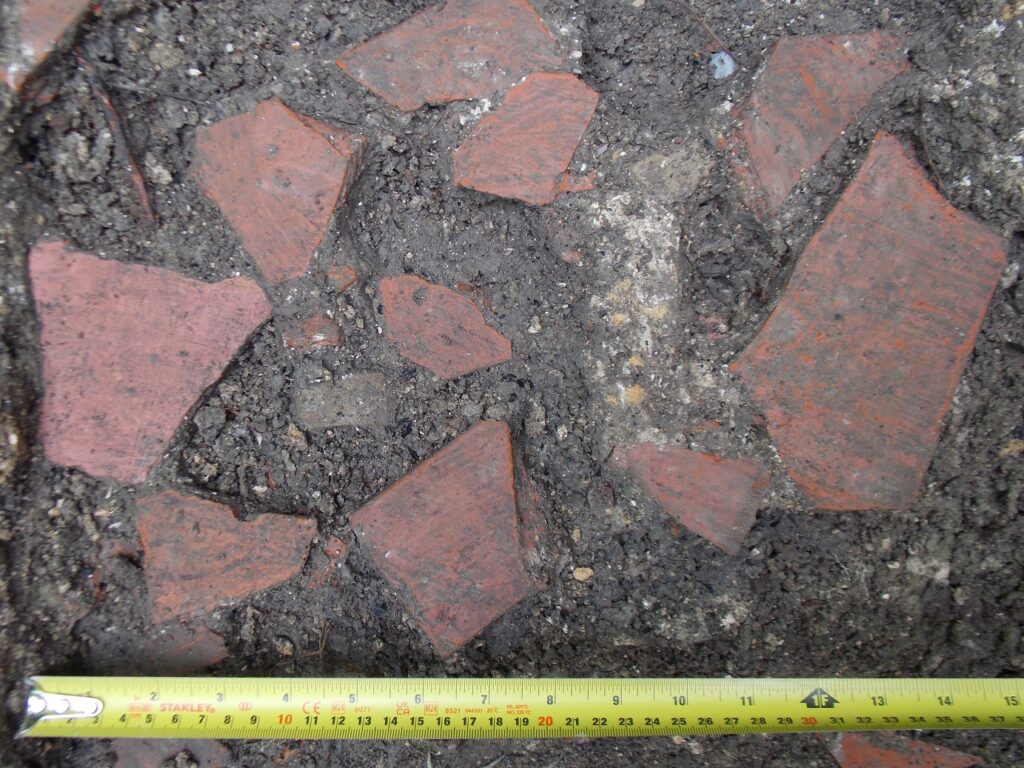
One notable feature of the excavation, from the finds coming from just a few centimetres below the surface, is the large quantity of smashed roof tiles. As well as these, we also find quite a few broken bricks as well as a few complete ones. Furthermore, we find significant amounts of sandy mortar alongside the bricks. Less obvious, but still in significant quantities, are fragments of window glass, and quite a bit of charcoal and evidence of burning. What we are uncovering is evidence of the building’s neglect, followed by abandonment and eventual demolition.
First, the windows were smashed. Perhaps local people, finding the building locked up and no longer being attended to, and being of an idle disposition picked up some stones nearby and used the windows for target practice. Once a building starts to appear neglected, it’s on a downward spiral. Someone breaks in and thinks it might be fun to start a fire. Or maybe the evidence of burning was from the structure’s ultimate demolition; roof trusses and other timber features of no value were piled up and set alight.
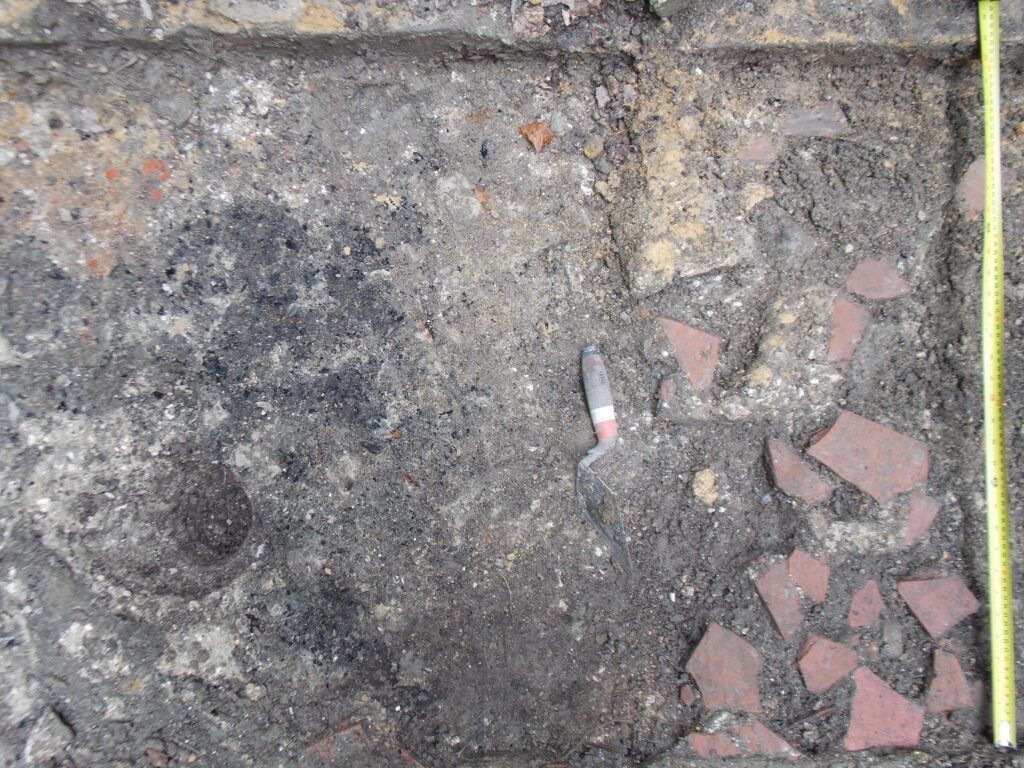
The broken tiles, bricks and mortar are clear evidence of the building’s deliberate demolition. This would have taken place once it was clear that the pumps would never run again and the well was properly out of use. Most excavations of stone or brick buildings come across a demolition layer, whether from Roman times, the medieval period, or from as recently as the nineteenth century. Some building materials were quite valuable and carefully recovered. The large amount of roof tile suggests that few if any of these were worth salvaging, although the near complete absence of ridge tiles (we have found only a few broken pieces) suggests that those were recovered. The level top of the foundation courses of the brick walls and the lack of significant numbers of whole bricks in the rubble is good evidence that bricks were carefully salvaged down to ground level, and the sandy mortar carefully removed from the bricks and dumped in the remains.
The sequence of layers of rubble gives some clues to the order of events. First the evidence of burning and glass, then the roof tiles immediately above, topped by bricks and mortar. Although it is not possible to be totally confident with this interpretation, there is some scope for learning more about the building.
For example, excavating a strip of ground adjacent to the inside walls of the building in a trench divided into one metre sections and recovering all the broken glass might reveal a distribution pattern that provides clues about where the windows were. In recent weeks, most recently on 27th June, two such excavations have been carried out and the following analysis of the glass fragments conducted.
Glass fragments were bagged separately according to their location in the trenches. They were then washed and dried. This was followed by weighing and counting, the results being plotted on scaled histograms. Another separate analysis of the glass thickness was made, showing a distribution with fragments varying from 2.1mm to 4.0 mm in thickness, the majority lying between 2.5 mm and 3.5 mm. The diagrams shown here illustrate the distribution of glass found along the lengths of both the north-east wall and the south-east wall. The former was probably a gabled end wall.
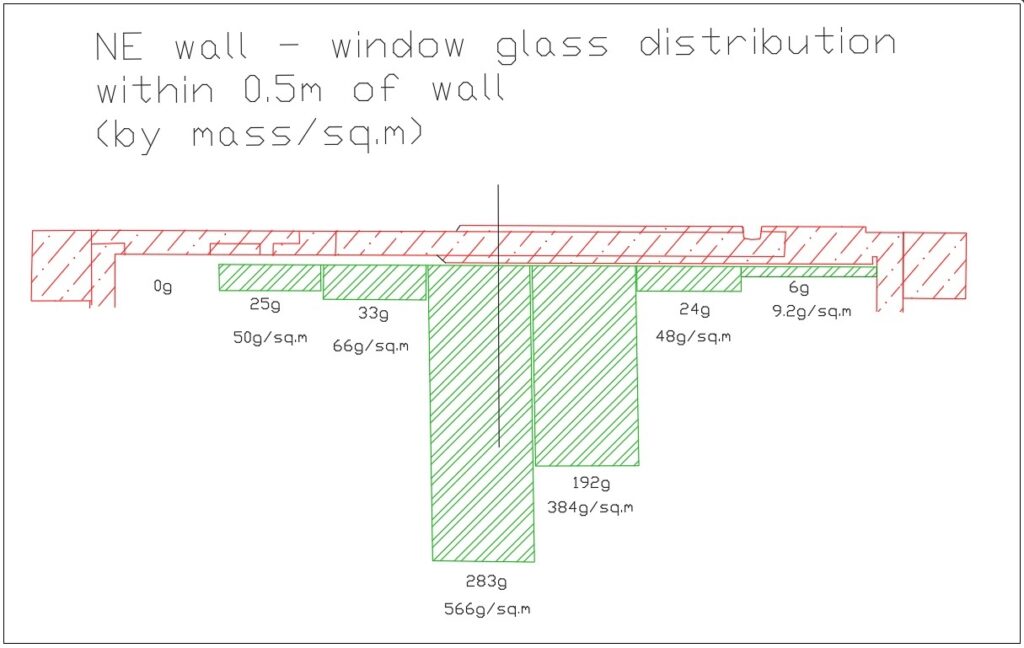
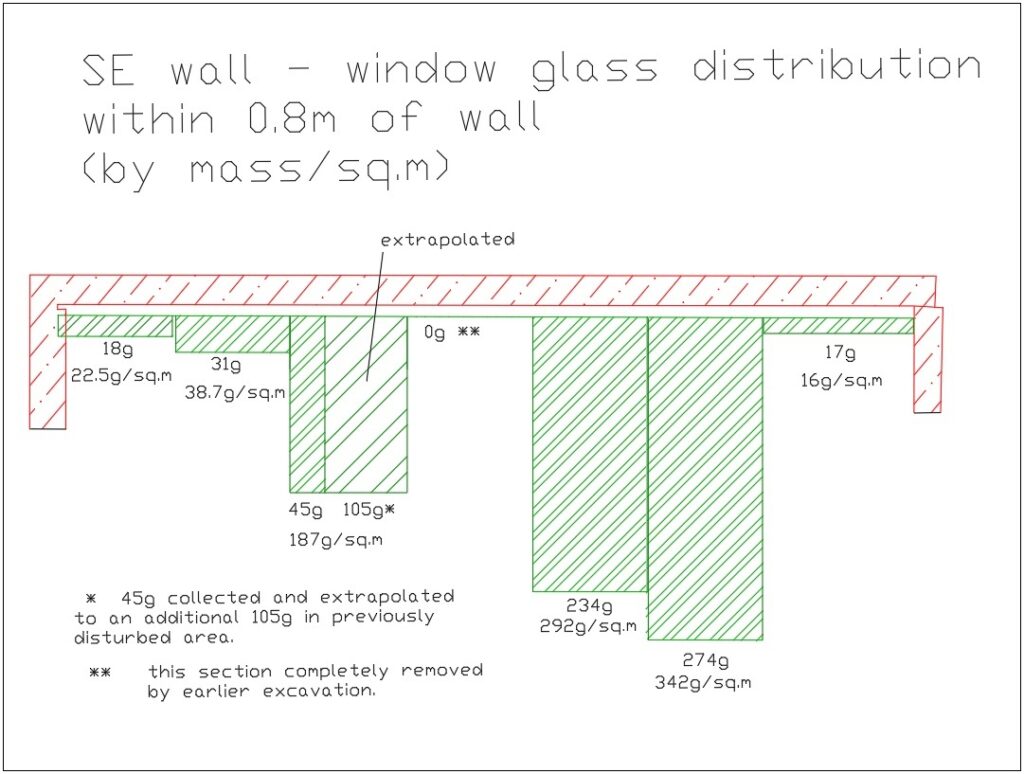
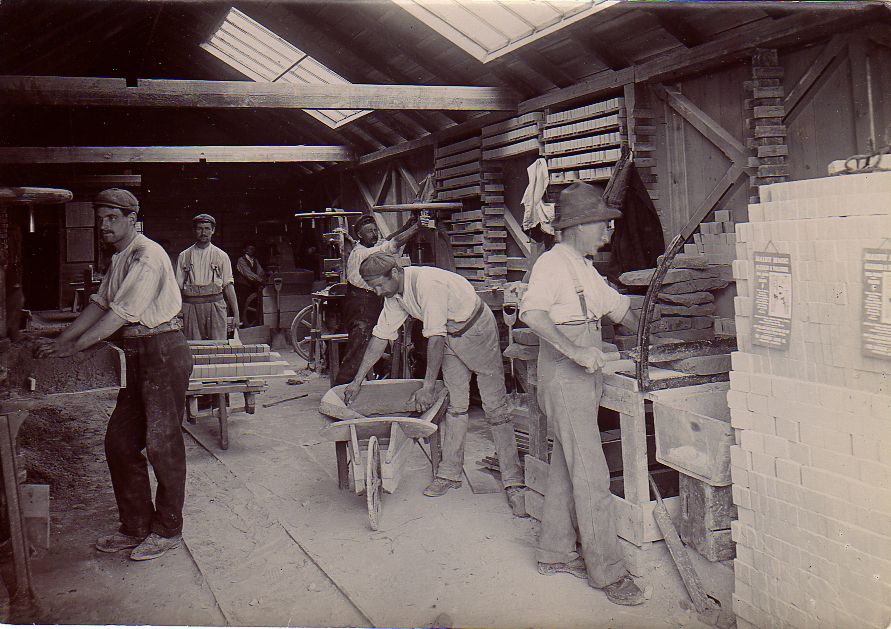
Initial thoughts are that there was a significant window in the centre of the gabled north-east wall, and possibly two windows spaced symmetrically in the south-east wall, but avoiding both ends. It is also possible that the glass came from skylights, similarly spaced on the south-east side of the roof. Photos of timber factory sheds built by George Taylor for his nearby hearthstone works some time after 1900 show them to have skylights rather than windows.
When was the pumphouse demolished? The building appears on the 1914 25-inch Ordnance Survey plan revised in 1912. A letter to the Surrey Mirror in July 1910 concerning the Kingswood Water Company refers to the idea of putting the Colley Well into full working order, which implies it was not in use at that time. In an account of the activities of the Buckland Beagles in January 1913, the Surrey Mirror described a hare being chased past the “old pumping station” onto Queen’s Park and over into the woods at Margery where it eluded the hounds.
Although we have not determined a date when the building was demolished, we can see that it was out of use by 1913. An agreement between the estate of the late George Taylor and the National Trust in September 1912 transferred ownership of land, including the old pumphouse, to the National Trust and it seems very likely that the new owners would have been anxious to have the old building removed as soon as possible.