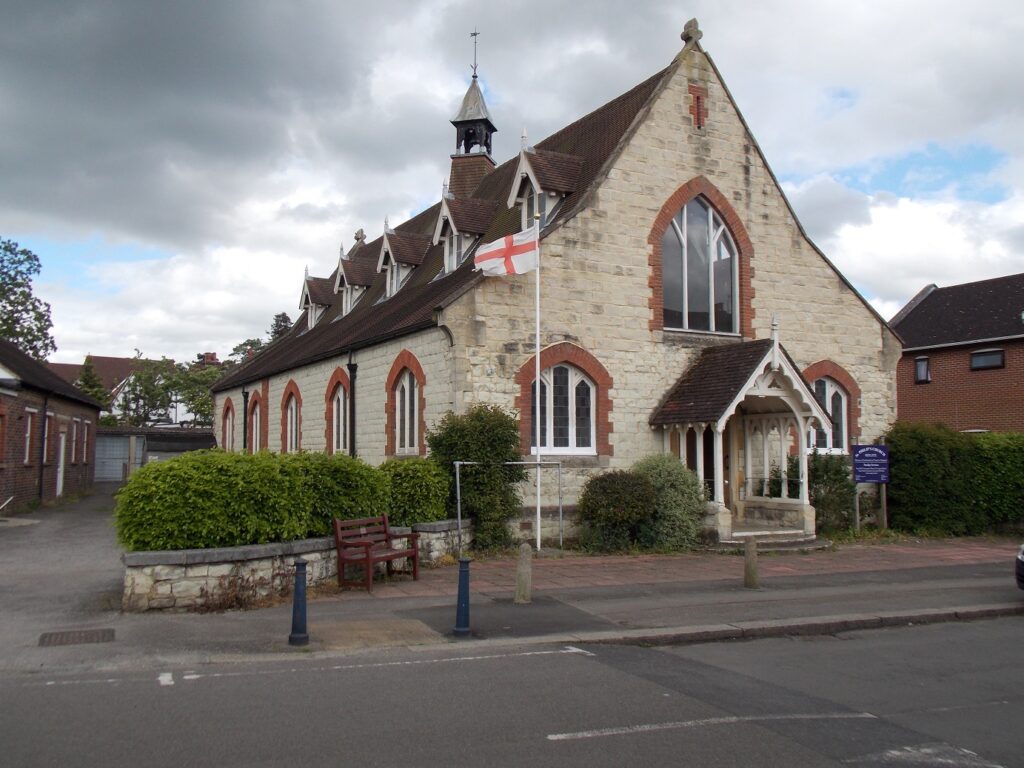
Although we have not posted any updates here for many weeks, this does not mean that we have stopped our investigations of the well and what lies underground here. On the contrary, we have made some exciting discoveries! It is only now that we can openly announce how successful we have been.
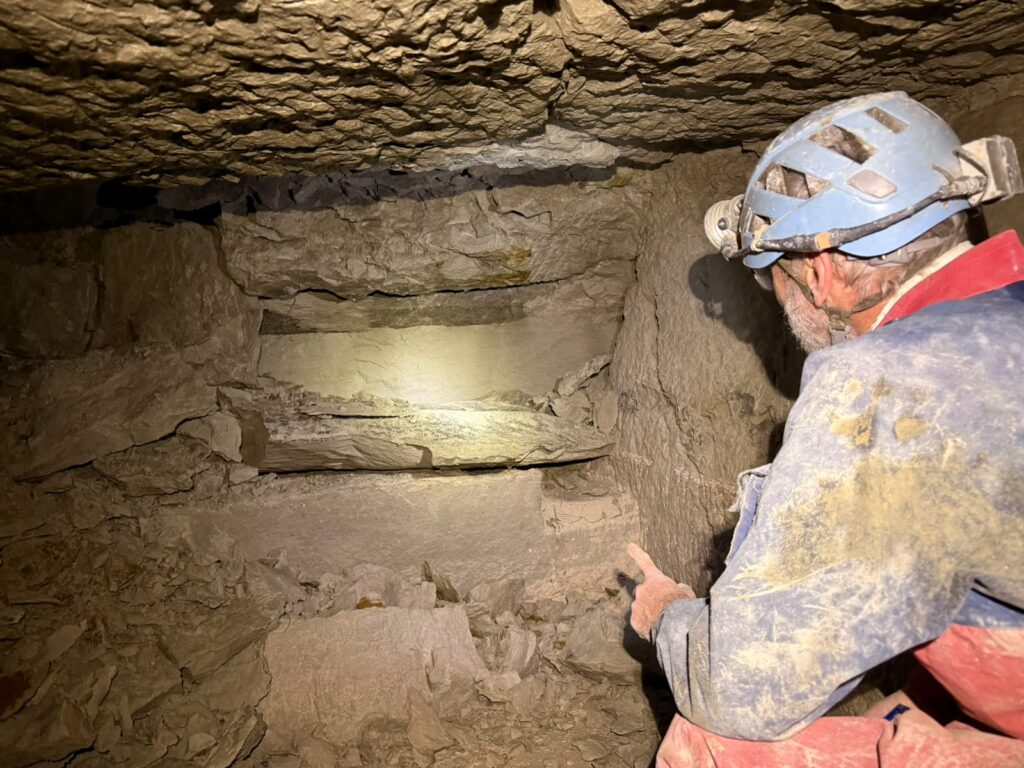


At the beginning of July we brought in a mechanical digger again and removed enough material from the deep pit in the centre of the pumphouse to expose an opening into a subterranean chamber that we had briefly accessed in 2015 during our first excavation. Meanwhile, we continued to investigate remains of the building and its surroundings but were also able to start work below ground to see if there were more extensive old quarry workings to study and quickly found that there are!
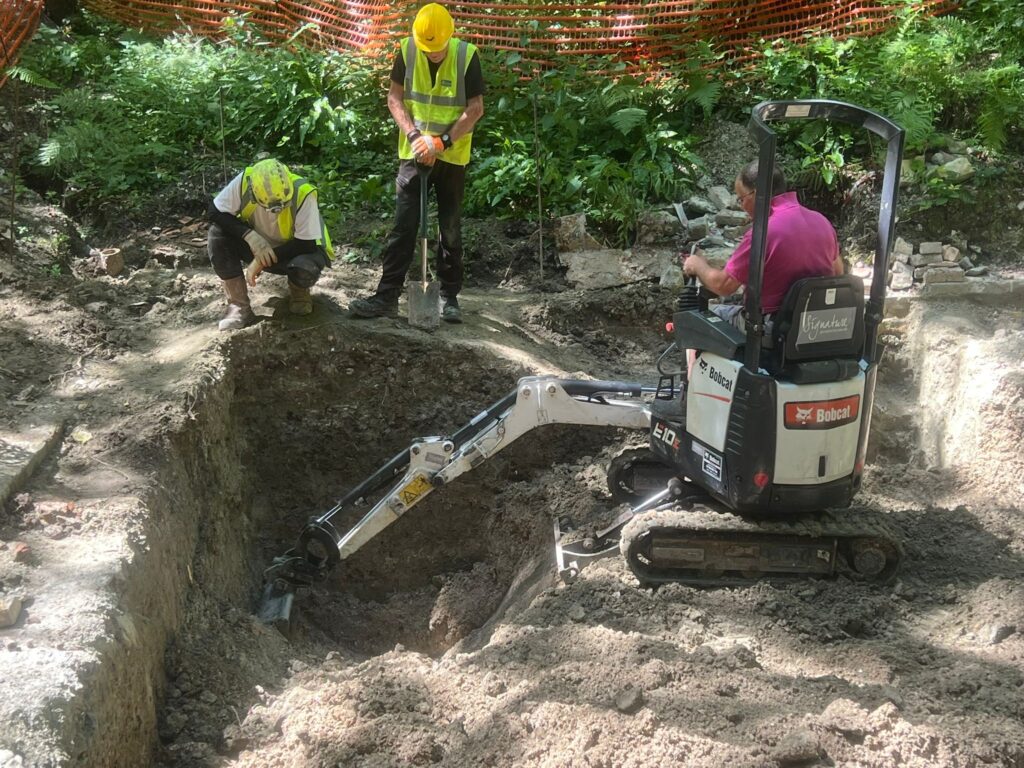
In 2015, we had noticed a small hole in the wall of the subterranean chamber, leading off to the east. At the time we could not investigate further as we didn’t have the tools to open it up, or the time or permission to do so. We had put a small endoscope-type camera through the hole and confirmed that there was “something” beyond, but it was obviously full of rubble almost to the roof. It would be another eleven years before we would be able to work here again.
Now, armed with a small battery-powered pick we quickly made the hole large enough to confirm that we definitely had something worthwhile to investigate. Removing the quarry waste beyond the hole until we could squeeze over it, we were soon able to walk around old underground quarry passages that had been abandoned and forgotten for almost 130 years.
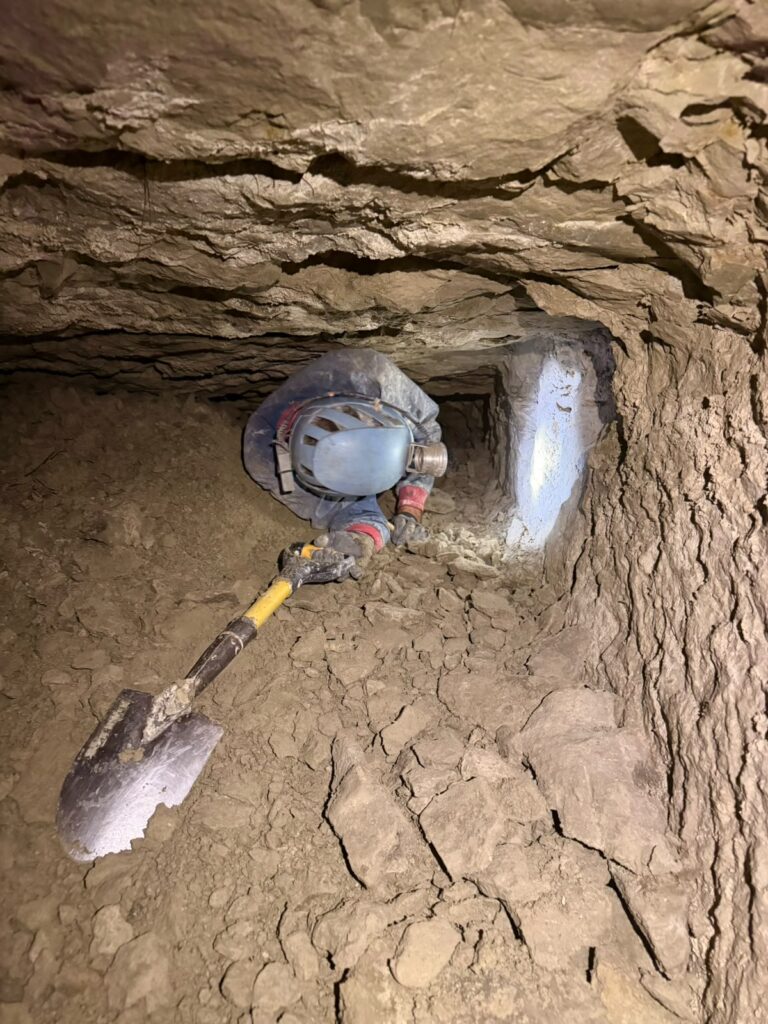
There was a noticeable draught coming through our widened hole which is normally a good sign of an extensive underground system. However, as we carefully made our way from one gallery through gaps in the walls into the next galleries, we soon discovered that there was nowhere particularly obvious we could identify as a source for the flow of air.
In all, we found six parallel quarry passages. Each one extended a little further sloping down to the north-east than the one before. Each one was sealed at its upper end either by fallen rocks or by piles of quarry stone waste. The floors of the first three galleries are extensively covered by washed in chalk and greensand rubble and silt, whereas the three more easterly galleries have much less of this, and the last two are effectively clear of washed in material. The passages also became noticeably wetter as we explored the eastern galleries, with persistent dripping water present even at the height of the severe drought experienced in 2026.
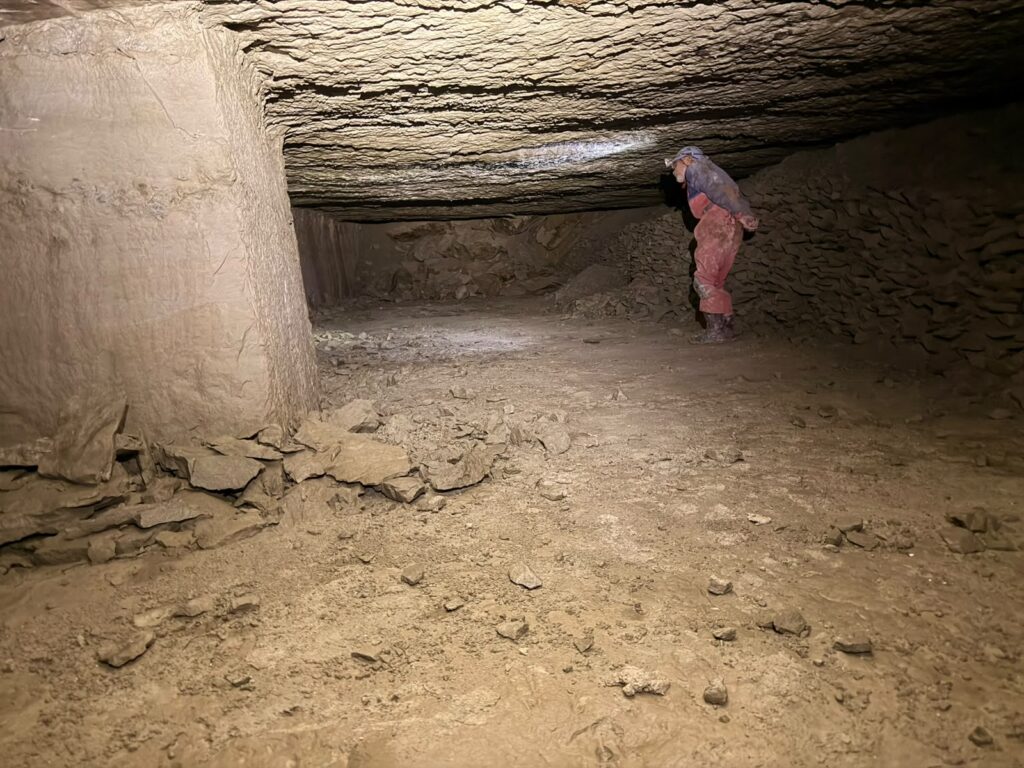
It was fantastic to discover even this modest amount of old quarry. However, we did still have more archaeology to finish on the surface. It was also important to ensure that the subterranean discovery was kept low key until we had installed a secure entrance to the tunnels. Now that this has been achieved, we can continue telling the story of the well and the old stone quarry under Colley Hill.
Our last significant workday took place on October 18th when we brought a digger back to the site and completed the construction of a permanent shaft, putting back the spoil excavated over many weeks around it. We left the site late in the afternoon and within an hour of packing up it started to rain. We had been so lucky with the weather throughout much of the season.
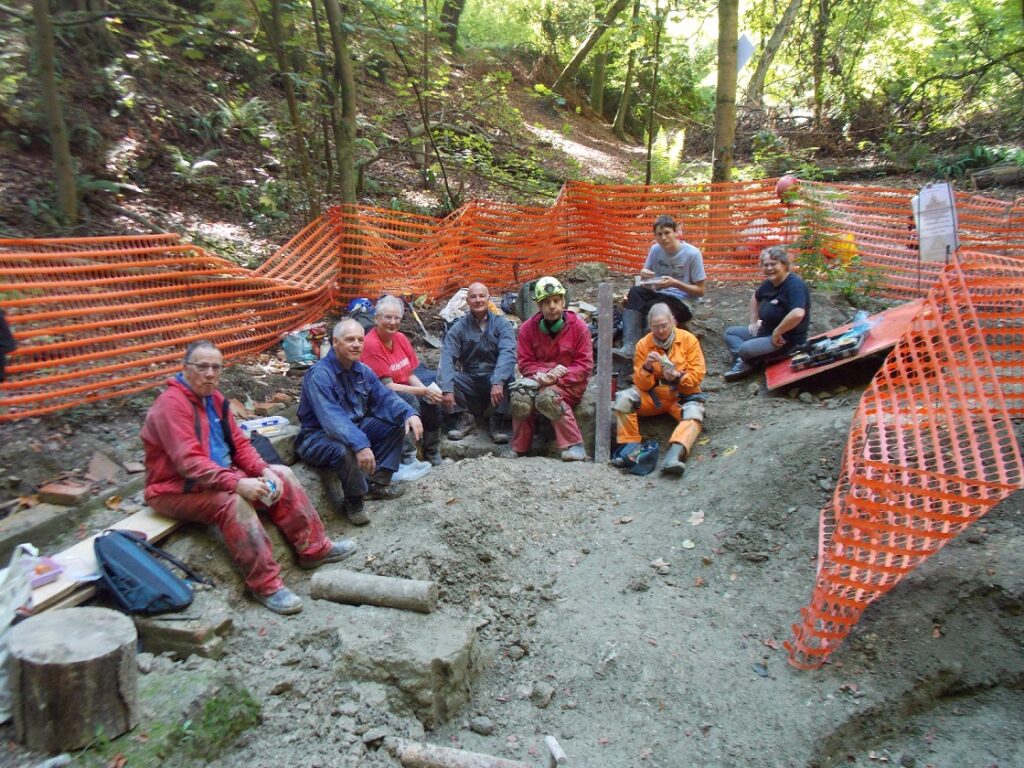
Do you recall I mentioned the draught flowing through the tunnels? Clearly a draught doesn’t just materialise from nowhere so we set about looking for the source. Using smoke generators normally used by domestic gas engineers, we checked a number of likely locations from one end of the system to the other. But it was only in one location that a slight draught was detected and confirmed later by repeating the test. This spot lies at one end of the most easterly gallery we have found, so this is where we plan to probe in the future in the hope of finding more passages.
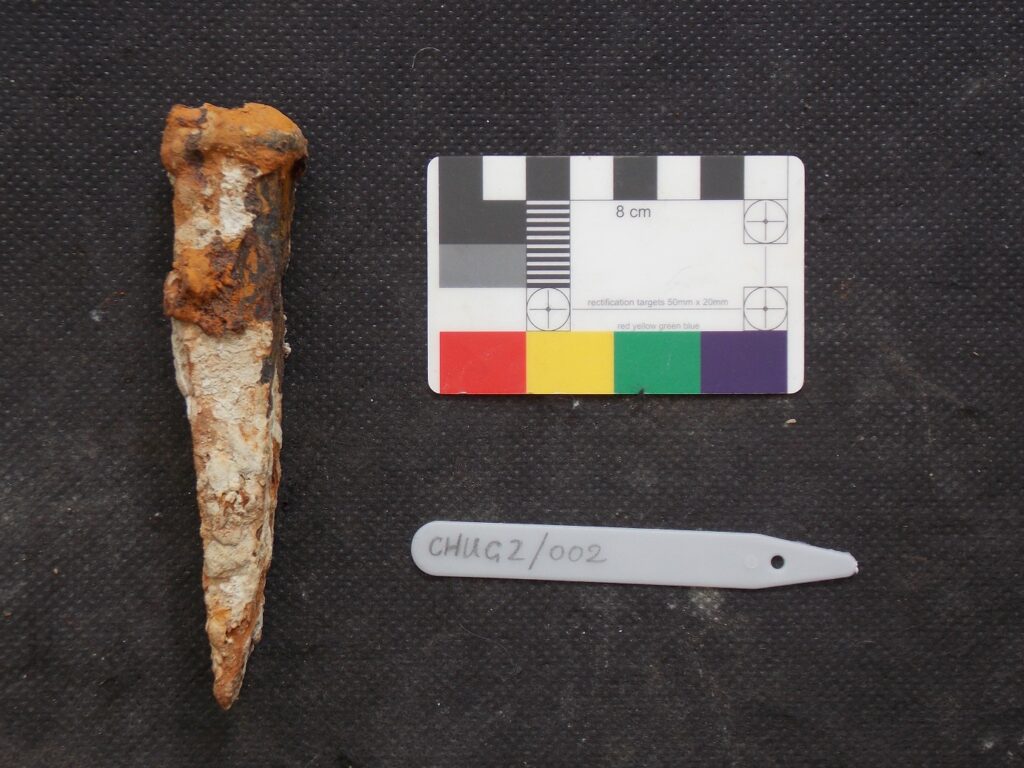
Within the workings that we have so far discovered we have found a few items of interest. Unless these are disturbed by our work when creating access routes, these are generally left in situ in accordance with the guidelines of the National Association of Mining History Organisations so that they remain in context. The most significant of these are a few quarrymen’s iron wedges used to split blocks of stone from the quarry face. These are very typical of the Reigate stone quarries, whether many centuries old or more recent ones such as those near Godstone, and now, of course, Reigate. We soon spotted two clay pipe stems on our first few visits. This immediately tells us that the tunnels are not a part of Reigate’s famous medieval quarries, sadly! A small piece of Welsh roofing slate left on top of a pile of quarry waste gives another clue on the age of these passages. It is unlikely that slate from Wales or from anywhere else made its way to Reigate in any significant quantities until the arrival of the railway to the area in 1841.
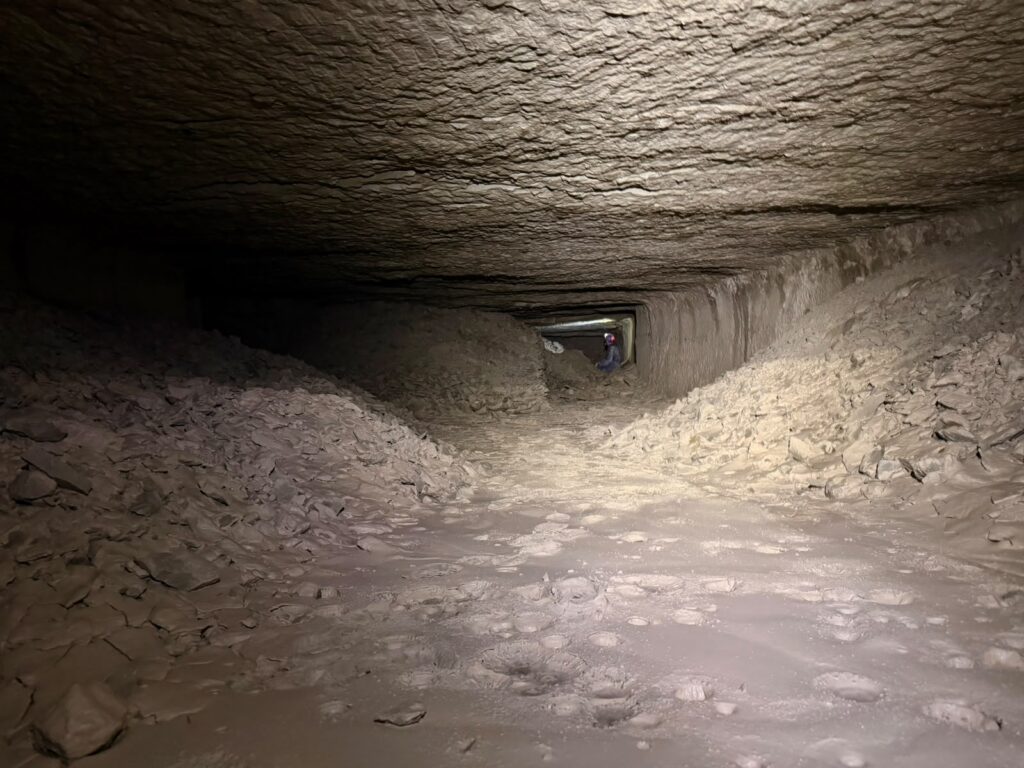
The tunnels are about one and a half metres high, so you can never stand up straight, but they are very wide – over eight metres in one place. In total, we have found about 220 metres of passage, heading eastwards towards the main part of Colley Hill, although only just running under the steep eastern side of The Horseshoe.
Future Plans
We are now in a position to carry out a more detailed study of the tunnels. There is much to investigate in a number of areas. Are the signs of flooding we see evidence for something that still happens in wet seasons? Why are there so many insects in one particular area? Some selective excavations may reveal more under the washed in spoil, like evidence of quarry cart wheel marks, or anything that may help provide a date for the quarry.
We would like to make it easier to reach the discovered passages from the entrance. Currently access is only possible by squeezing through a hole and then crawling on your stomach for a short distance. While cavers might be happy with this, others wanting to help with the research are less likely to enjoy this experience. We want to open out this section a little more by increasing the width of the hole and deepening the floor of the crawl.
Recent Finds
The number of new interesting finds on the surface dropped as the weeks passed. This was mainly due to our work being deeper within the well pit which appears to have been deliberately filled in one go using quarry waste with little of interest in it. It was not possible to excavate the pit entirely due to site constraints. We did, however, reach the base of the pit in one corner when we installed the entrance and had a brief glimpse of the entire side wall from top to bottom, which was sealed with a cement render over a coarse concrete comprising clinker, ash and other rubble.
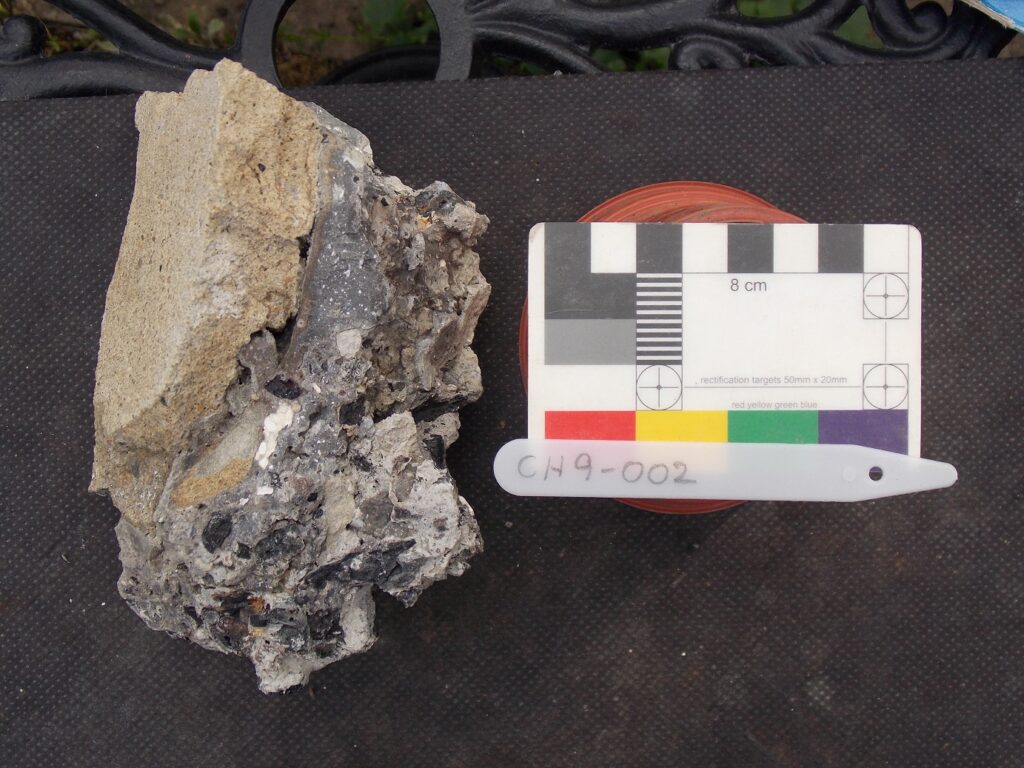
Unfortunately, we did not find any further evidence of a pumping mechanism, the steam engine that powered the pump, or the boiler that provided steam for the engine. Due to space constraints, it is most likely that the steam engine would have had a vertical steam cylinder and a large flywheel powering a reciprocating pump rod in the well shaft. By using a hand auger, we confirmed that the well itself was located at the north-eastern end of the pit.
The Quarry Tunnels
What we have found at Colley Hill is similar to Upper Greensand workings elsewhere in Surrey. Typically, the quarrymen drove a low, wide tunnel into the Reigate stone bed perpendicular to the natural cracks and fissures in the ground. This made it easier to remove squared stone blocks, keeping waste to a minimum. The blocks of stone were extracted by hand using picks and iron wedges to split the bed on its natural bedding planes. The blocks would have been loaded onto a low quarry truck and hauled up the passage to the surface quarry yard. We don’t yet know whether this would have been done by hand or using ponies, the latter being the preferred option in the Godstone quarries.
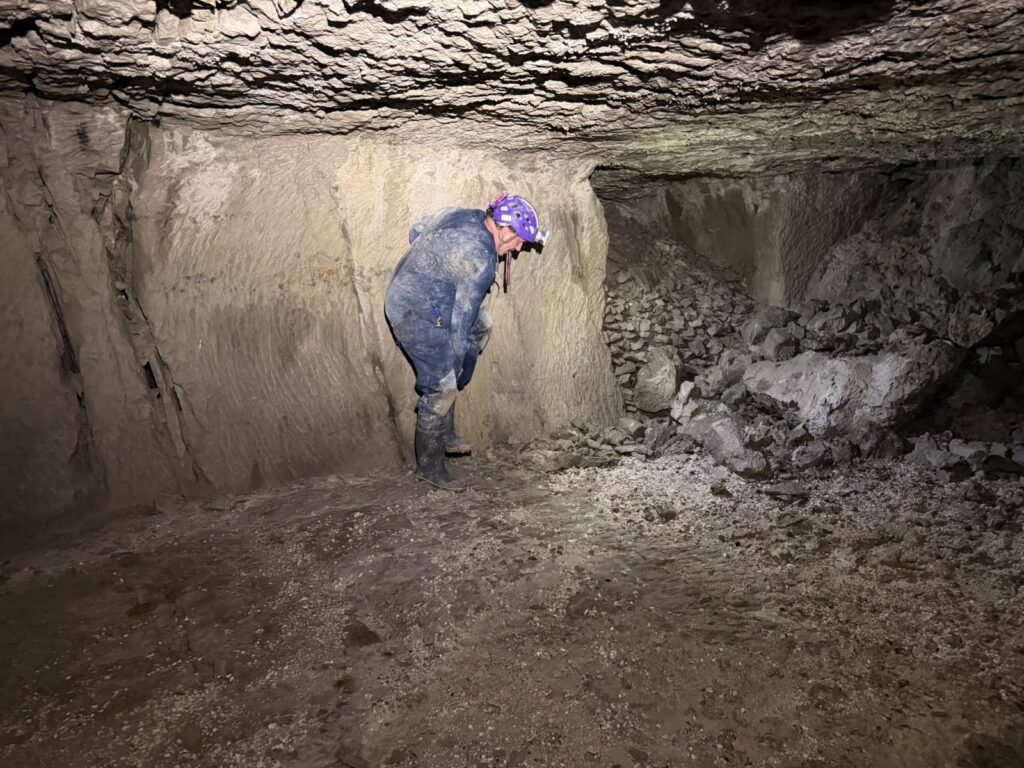
The quarry tunnels were cut parallel with a solid wall of stone separating them. Each passage was connected to its neighbours through “eyes” cut through the otherwise solid walls. These allowed more stone to be recovered, quarry waste to be stacked up out of the way in a worked out tunnel, and it also improved ventilation.
Who Dug The Tunnels?
It is difficult to know precisely who was working Reigate stone from these tunnels. However, we have some confidence that they date from around 1850 onwards. One person is known to have worked Reigate stone from Colley Pits at this time, and that was a local builder and contractor called William Carruthers. He advertised a new quarry he had opened for “firestone” (another name for Reigate stone) near Reigate in the “The Builder” in 1850. Carruthers was subsequently responsible for building a number of structures in and around Reigate, often using Reigate stone. Many of these are still standing, especially around the area of St. Mark’s church, but also elsewhere in the borough, such as St. Matthew’s Church in Redhill (1865). If you live in a nineteenth century house in Reigate that contains Reigate stone, there is a good chance the stone was dug at Colley Pits by Carruthers.