Bring in the Bobcat!
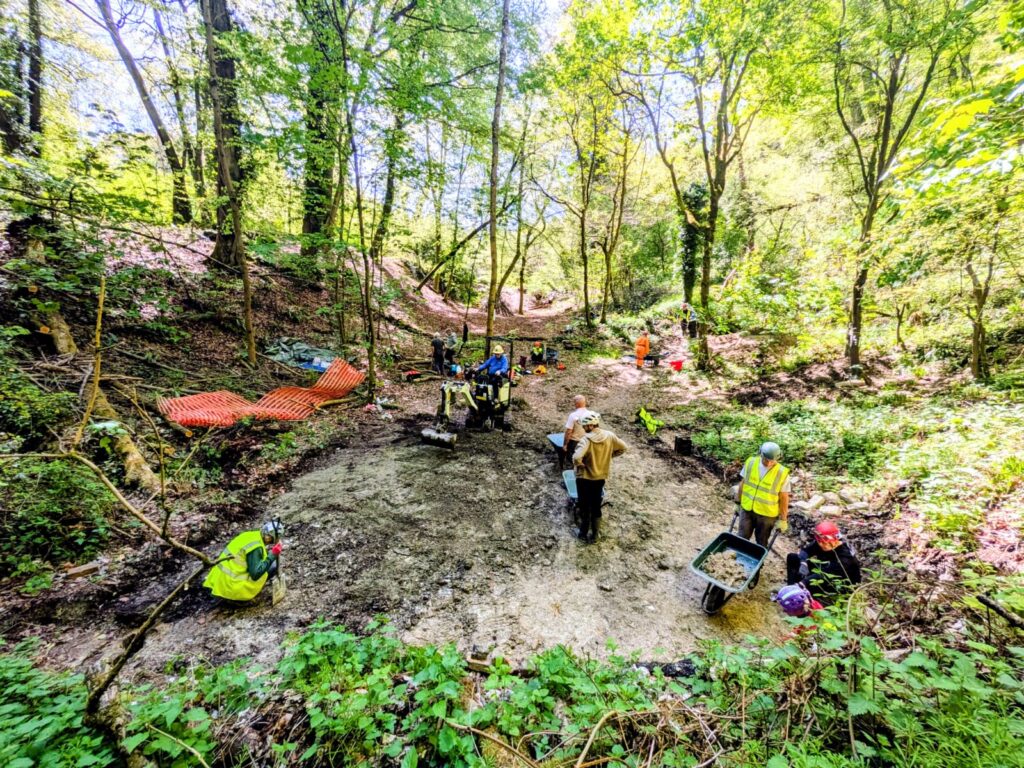
It feels as if we have just made a huge leap forward with the dig. We knew that we had a large quantity of overburden to shift so we could get down to the interesting stuff. For more than 100 years, the old quarry has become overgrown, soil and chalk has washed down into the pit bottom, covering the demolished pumphouse. At the corner closest to the hillside, we have already found that material considerably more than a metre deep has accumulated inside the area being excavated and needs to be removed in order to get down to the archaeology. Meanwhile, don’t forget to check out more photos of our latest efforts in our photo blog galleries.
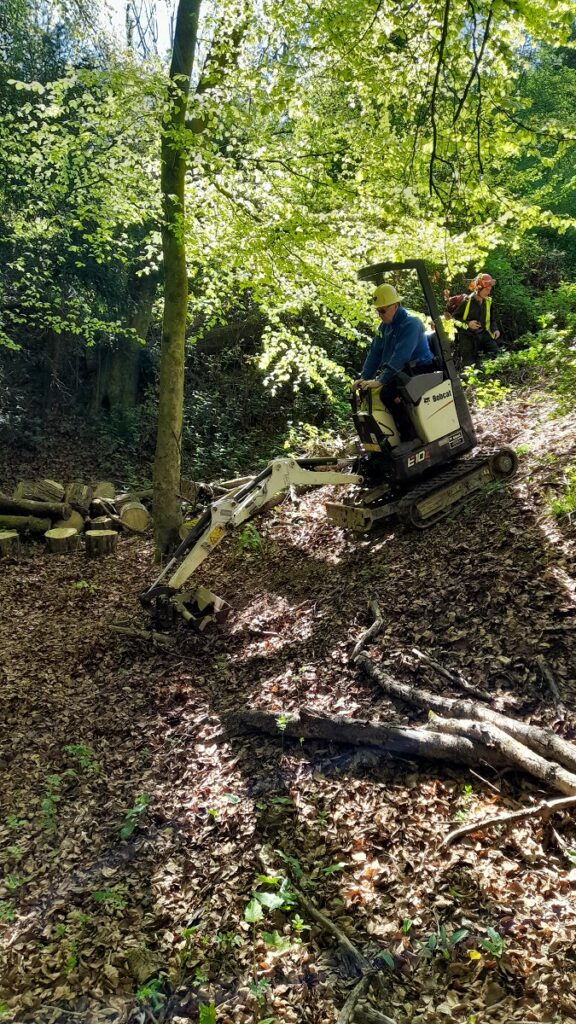
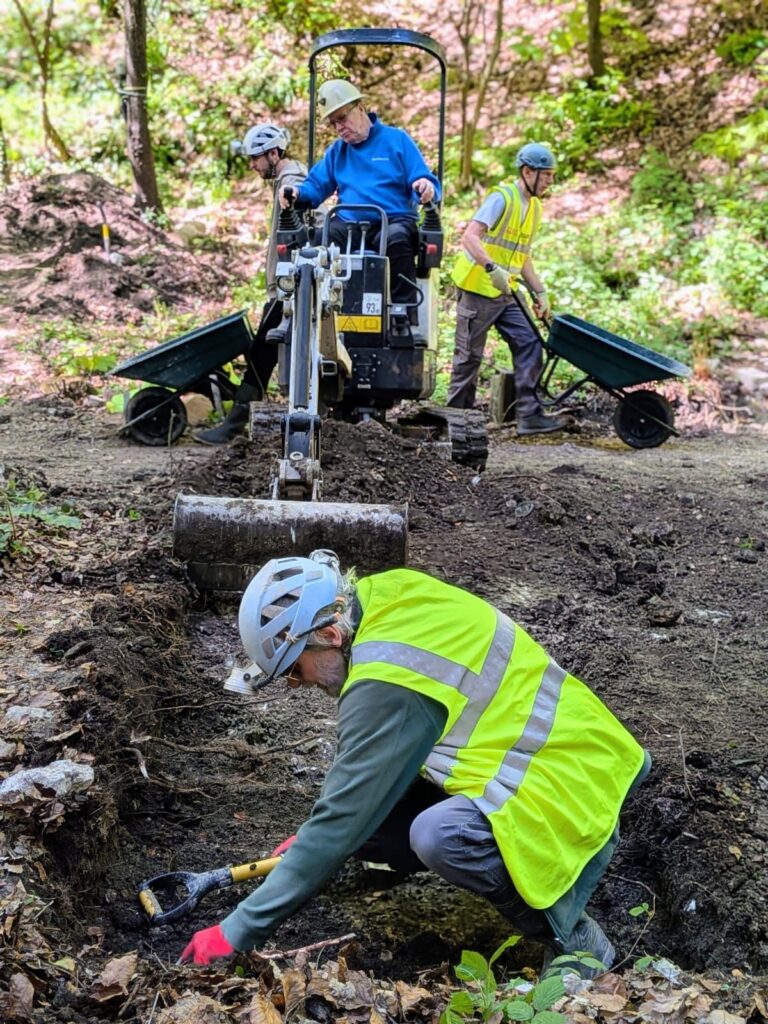
We borrowed a small Bobcat excavator to strip off most of the overburden. Our first challenge was to get this machine from the end of Underhill Park Road to the Horseshoe Pit. This is a footpath quite popular with dog-walkers and others, especially on a lovely spring day. Of course we met several people at the narrow spots where there was little room to pass, but at least it gave us a chance to chat and to explain what we were hoping to do later in the day.
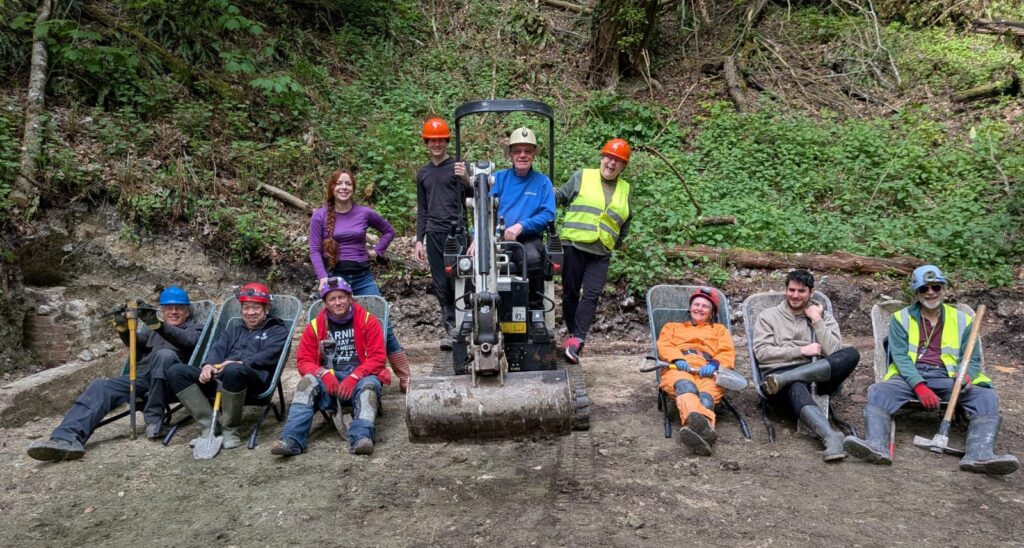
With a good team of volunteers ready, we started work, with a train of three wheelbarrows running from the digger to our spoil pile trying to keep up with Neil our volunteer digger driver. We got into a steady rhythm as the pile slowly grew and we began to see more of the pumphouse floor appearing. However, our barrows, all of which had seen better days, became less cooperative. One fell in two with the frame parting company with its top, and a second lost its wheel when the axle crumpled under the weight.
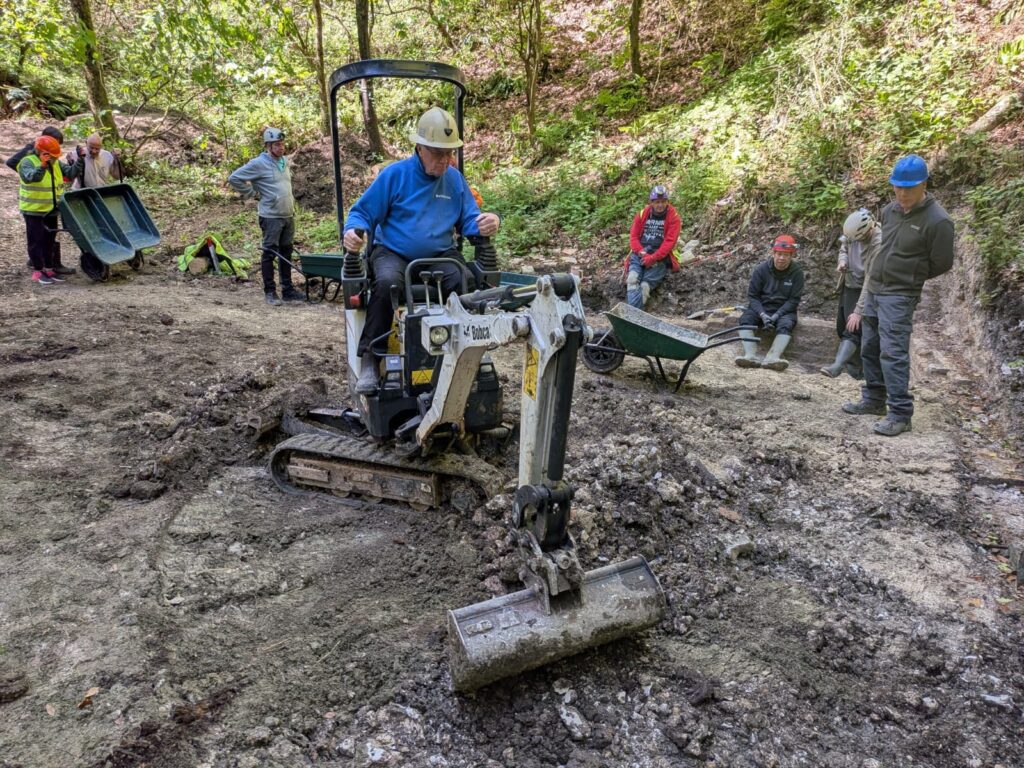
A team was urgently dispatched to buy four new barrows and get back as quickly as possible. Meanwhile, we valiantly struggled on with what remained of the barrow fleet, one now held together with cable ties. The replacement barrows arrived within the hour and we didn’t look back. The work continued uninterrupted for the rest of the day.
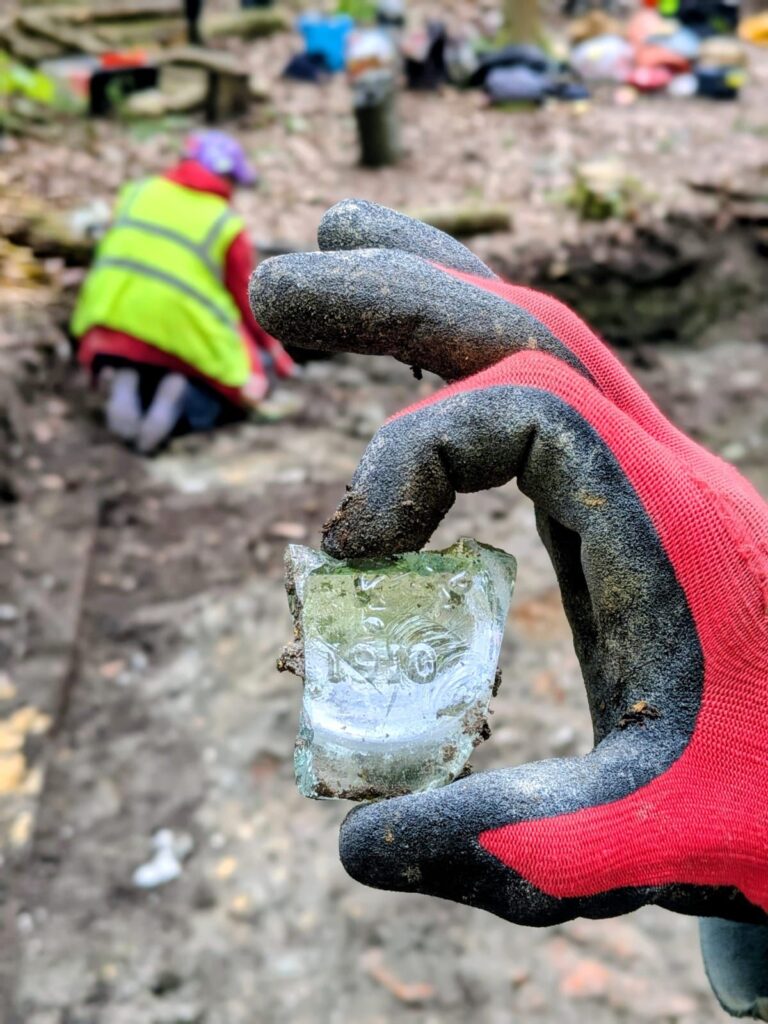
What did we achieve? We have cleared the entire interior of the pumphouse down to a level just above the original floor, although this doesn’t appear to be very well defined and may have been no more than rough compacted “earth”. We found comparatively few items of interest but these did include three complete jars or bottles, and our first complete roof tile. Neil estimated that we had moved between 20 and 30 tons of material. We can now see quite clearly the location of the former well, its outline obviously showing in the centre of the pumphouse. We believe that at some time the material originally used to cover the well slumped creating a deep crater on the surface and that this was then filled with material from a conveniently nearby bank of greensand. This shows up clearly against the whiter chalky material that makes up the pumphouse floor.
Above all, we have shown how well we can get a challenging job done, all the while having a really enjoyable time. We are now in a position to discover what remains below the pumphouse floor. We know from our earlier investigations in 2015 that much of what remains to be found lies lower down. The big challenge will be to locate and empty the “engine room” the floor of which was three to four metres below ground level. We will be using an excavator again once we have recorded everything at ground level.